.svg)
How Did We Not See This Coming?
Confidence without validation is overconfidence.
A competitor moved first.
A partner changed direction. Customer behavior shifted. A new revenue opportunity appeared. By the time the organization responded, the advantage belonged somewhere else.
Then someone asked the question leaders across sports have asked before:
How did we not see this coming?
The uncomfortable answer is that the organization probably did.
Someone noticed. Someone raised a concern. Someone shared information or recommended action. But what people saw remained scattered across conversations, departments, reports and individual judgment. No single signal felt strong enough to challenge existing priorities, so the commitments stayed the same while the marketplace changed.
The better question is: Why didn’t what we saw change what we did?
The Marketplace Constant Is Change
Sports organizations are reacting at every level.
Youth sports properties are consolidating and attracting institutional capital. In 2025, DICK’S Sporting Goods led a $120 million investment in Unrivaled Sports to expand its portfolio of facilities, tournaments, camps and experiences.[1]
High school athletic associations are rewriting rules as commercial activity reaches younger athletes. Ohio’s member schools approved a bylaw allowing high school athletes to earn compensation from their name, image and likeness beginning in November 2025.[2]
At the highest level of college athletics, change is no longer theoretical. Universities have already decided the traditional athletics model is not built for the marketplace they are entering. What they have not decided is what should replace it.
Clemson began consolidating its commercial operations through Clemson Ventures in 2024.[3] Kentucky followed by moving the broader athletics enterprise into Champions Blue LLC.[4] Since then, Charlotte, West Virginia, USF, Texas Tech, Utah, Rutgers, Michigan State and Virginia Tech have introduced different structures involving commercial rights, fundraising, athlete compensation, outside capital or athletics governance.[5–12] UNC is now reportedly preparing another version.[13]
None of these models are exactly alike.
That does not mean the decisions are wrong. It means there is no validated market consensus about what the future operating model should be. Each institution may have justified confidence in its own decision, but that confidence cannot be established from the formation announcement alone. We would need to understand the evidence considered, the alternatives evaluated, the assumptions still being carried and the outcomes the institution expects the new structure to produce.
Clemson offers encouraging early evidence. Sports Business Journal reported that Clemson Ventures generated more than twice the gross and net revenue of Clemson’s final year with its previous multimedia-rights partner.[14] But one early result does not validate every structure now being created. Most of these entities are too new to demonstrate whether their governance, capital and commercial decisions will produce better long-term outcomes.
Universities are reacting. The question is why each one believes its particular structure is the right response.
Is each institution choosing the model best suited to its market, assets, capabilities and ambitions? Or are universities experimenting because the marketplace has changed faster than anyone can validate what should come next?
That is the real risk. Change creates pressure to act. But action alone does not create justified confidence. Confidence without validation becomes overconfidence.
Professional leagues are reconsidering structures that once appeared permanent. In 2024, NFL owners approved institutional investment in team ownership for the first time.[15]
These decisions demonstrate awareness. They do not automatically demonstrate understanding.
What validated intelligence established that an acquisition, policy change, LLC or new ownership structure was the right response? What evidence determined the timing? What outcome would validate the decision? What new information would cause the organization to reconsider it?
The issue is not whether sports organizations are reacting. They are. The issue is whether they are reacting with validated intelligence—or responding confidently because standing still feels impossible.
The marketplace keeps moving. Fans change how they spend their time. Brands change how they invest. Technology changes customer expectations. Team dynamics change quickly at every level as players develop, transfer, become injured or leave; coaches change; rosters turn over; and chemistry shifts.
Consider a youth soccer club entering a season confident in its competitive position. Then a competing club joins a stronger national platform. A respected coach leaves. Two important players transfer. A new league creates a different path to college exposure. Families begin comparing the club with opportunities that did not exist when its plan was established.
No single change defines the club’s future. Together, they may change what families value, where talent moves and whether the club’s current position still deserves confidence.
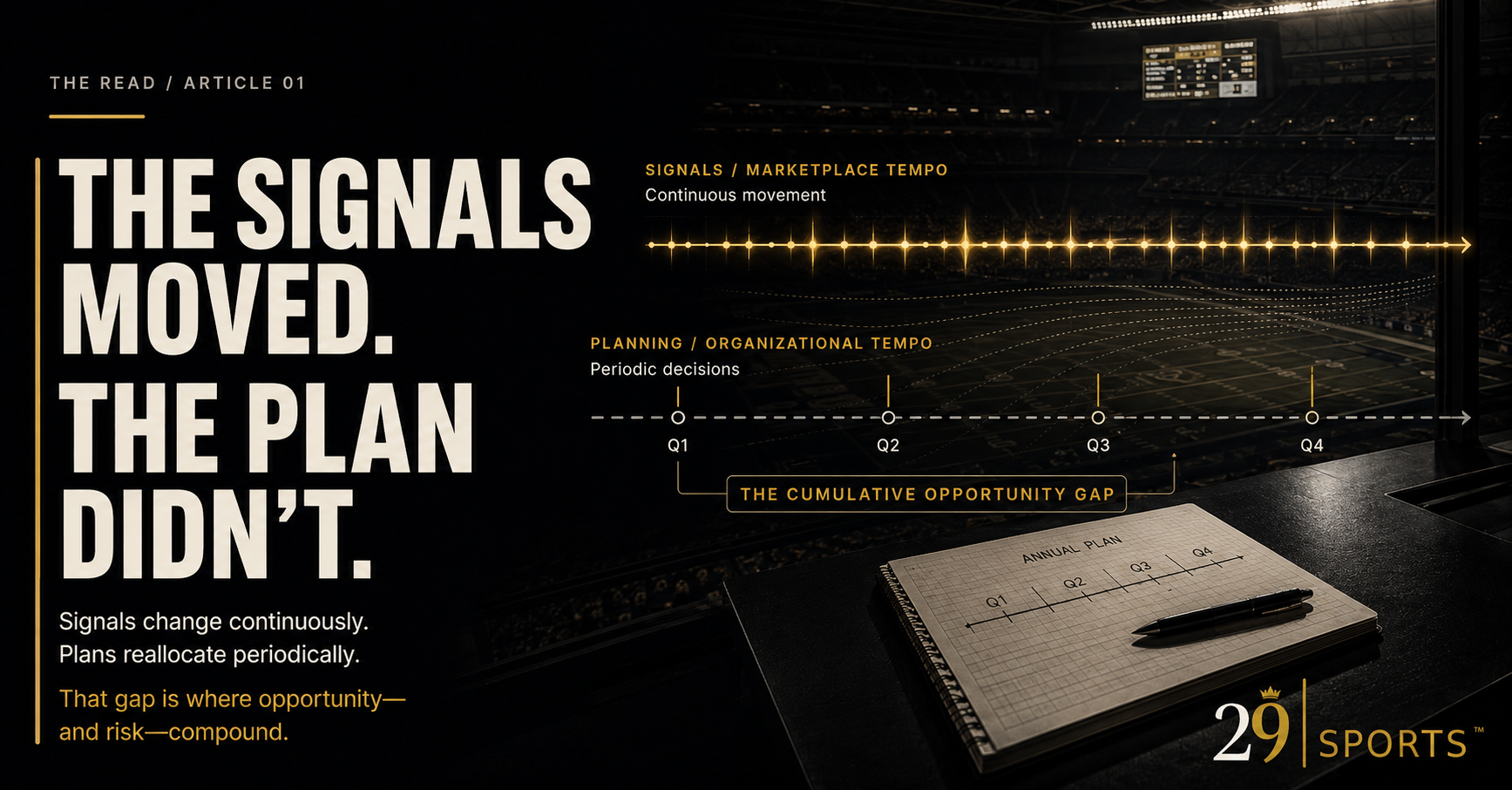
That is Sports Marketplace Tempo™: the rate at which change alters what matters, what is possible and where opportunity lives.
Organizations Are Built to Commit
Organizations cannot change every time the marketplace moves. Budgets, staffing, partnerships, technology and operating plans require commitment. That is how organizations focus and execute.
Consider a high school that commits to strengthening its basketball program. It hires a coach, establishes a development model, invests in facilities and builds a three-year plan. Those commitments should not change every time a player transfers or a competitor improves.
But what happens when enrollment patterns shift, the coaching staff changes, the roster develops differently than expected and new commercial rules influence how families evaluate schools?
The original plan may still be right. It may need adjustment. Or the assumptions supporting it may no longer be true.
Organizational Tempo™ is the rate at which an organization reassesses and reallocates its attention, resources and commitments. It is naturally slower than marketplace tempo. The two will almost never move together—and they do not need to.
The risk is that the organization cannot recognize when the distance between them has become material enough to require a decision.
More Is Not the Answer
The answer is not AI.
Organizations are investing in AI while continuing to hire consultants to explain what the technology produces, what the market is doing and what leadership should do next.
The answer is not more consultants. Consultants can bring valuable expertise, but their work is usually designed around a defined question and delivered at a moment in time.
The answer is not more data. Most organizations already have more data than their leaders can consistently connect, interpret and use.
The answer is not another dashboard. A dashboard can show what changed without establishing why it matters or whether the organization should change with it.
Consider a professional organization facing declining engagement in one customer segment. It commissions research, hires a consultant, adds a dashboard and uses AI to summarize customer feedback. The research uses one customer definition, the dashboard measures another, the consultant evaluates a limited period and the AI summarizes what it receives without validating whether the evidence is complete.
The organization now has more outputs but no shared understanding of what is changing, why it matters or what decision the evidence supports.
AI can accelerate analysis. Consultants can provide perspective. Data can reveal signals. Dashboards can organize information. None of them, independently, creates validated understanding.
A recommendation is easy. Justified confidence is not.
AI can produce a strong recommendation. The 29 Sports Intelligence Platform tests whether that recommendation has earned justified confidence.
That test examines the evidence, assumptions, contradictions, materiality, timing and authority behind the recommendation. The process remains human-authorized: the platform is designed to strengthen judgment, not replace the people accountable for making the decision. New evidence may justify review, but it cannot directly change an intelligence state, commitment or decision.
The Intelligence Gap
Most organizations do not have an information problem.
They have a validation problem.
Information lives in customer conversations, performance data, market reports, partner feedback, financial results, competitive activity and the experience of people closest to the work. But it rarely arrives in one place, at the same time, with the same meaning.
Consider a college athletic department preparing for revenue sharing.
Development sees donor fatigue. Ticketing sees changing attendance behavior. Coaches see rising athlete acquisition and retention costs. Corporate partnerships sees new commercial opportunities. Finance sees an operating model under pressure.
Each team possesses useful information. Unless those signals are connected and validated together, leadership cannot determine whether it is facing a temporary budget problem, a commercial opportunity or a structural change requiring a different operating model.
The organization is left with two risks: react too early to something that does not matter, or react too late to something that does.
This is the intelligence gap: the distance between what an organization can observe and what it can confidently validate.
When that gap remains open, decisions are shaped by whichever signal is loudest, whichever leader is most persuasive or whichever problem has become too visible to ignore.
That may produce action. It does not produce justified confidence.
Intelligence Must Operate as a Loop
Closing the intelligence gap does not require predicting every change. It requires continuously testing whether what the organization believes is still supported by evidence.
That cannot depend on an annual strategy session, a quarterly report or the arrival of a crisis. Intelligence must operate as a loop:
Discover what is changing.
Understand why it matters.
Prioritize what deserves attention most.
Build the roadmap for what to do next.
Improve through action and validated outcomes.
Repeat as new evidence becomes available.
Consider a professional venue preparing for its next season. Ticket sales remain strong, but fans are arriving later. Mobile food orders are increasing while concession revenue declines in some locations. Premium customers want different experiences. Staffing costs are rising. Complaints about entry times appear in surveys, social media and frontline reports.
A traditional process sends each result to a different department. Ticketing sees attendance. Operations sees entry times. Food and beverage sees transactions. Partnerships sees premium expectations. Human resources sees staffing costs. But the fan experiences one connected environment.
The intelligence loop connects the signals, validates what is driving them, establishes which friction matters most and provides a roadmap for testing a coordinated response.
That roadmap should exist for every validated priority—not only when risk is elevated. It should define the intended outcome, next actions, milestones and validation points. When inherent risk exists, it should also identify mitigation steps, decision triggers and alternative paths.
The first response may work. It may solve one problem while exposing another. Or the outcome may show that the organization misunderstood the original signal.
That is why the loop repeats.
Success Is Not Declared. It Is Validated.
A program launched. A partnership signed. A platform implemented. A campaign delivered. Each milestone proves that the organization did something. None proves that the decision worked.
Consider a youth sports organization introducing a player-development program. Enrollment increases. Coaches complete training. Families attend the launch. The organization publishes new standards.
Those are signs of implementation, not evidence of athlete development.
The organization must return to the intended outcomes. Are athletes demonstrating measurable improvement? Are coaches applying the model consistently? Do families better understand their athlete’s progress? Are athletes being placed in environments aligned with their needs? Are the results consistent across teams and age groups—or isolated to a few strong environments?
The answers may show that the program works. They may reveal that the concept is right but execution is inconsistent. Or they may show that enrollment created the appearance of success while athlete outcomes remained unchanged.
An unvalidated success can be as dangerous as an obvious failure. Failure forces reconsideration. Apparent success encourages an organization to invest more, expand faster and repeat assumptions that were never proven.
Validated outcomes demonstrate what worked, for whom, under what conditions and what should improve next.
Intelligence Must Belong to the Organization
When validated understanding lives only with an individual, the organization does not own it. It is borrowing it.
Consider a college athletic department preparing for a coaching transition. The departing staff knows which recruiting relationships are strongest, why athletes chose the institution, where the roster is vulnerable and which commitments were made to families.
Some information exists in databases, evaluations, emails and messages. The reasoning connecting it may leave with the staff.
The next team inherits names, rankings and files. It may not inherit validated understanding: why one market was prioritized, which evaluations proved accurate, which assumptions shaped the roster or which early warning signals were missed.
Without a system for preserving those answers, a personnel transition resets organizational intelligence.
A continuous intelligence system captures the evidence behind important decisions, preserves what outcomes taught the organization and distinguishes validated understanding from assumptions that still need testing.
The goal is not to diminish experienced people. It is to make their knowledge more valuable by connecting it to evidence, testing it over time and allowing the organization to use it again.
Validated Intelligence Compounds
An organization should become more intelligent with every important decision it makes.
Consider a sports agency advising athletes across different sports and career stages. One athlete changes teams and gains commercial interest. Another joins a more visible program but sees little change. A third grows a large audience that produces few meaningful opportunities. A fourth has a smaller audience but delivers stronger engagement and better brand outcomes.
Treated separately, they are four client experiences. Connected and validated, they begin answering more valuable questions.
When does changing teams improve commercial opportunity? Which audience characteristics matter more than follower count? Which recommendations consistently produce better outcomes? Where has conventional wisdom been supported—and where has it been disproven?
The first decision produces an outcome. The outcome produces learning. The learning improves the next decision. Over time, the organization develops proprietary intelligence that cannot be created by purchasing another dataset or asking AI a better question.
Competitors can copy a program, hire similar people and buy the same technology. They cannot immediately copy an organization’s accumulated understanding of what works, why it works, for whom it works and when the evidence says it should change.
That is when intelligence stops being a project and becomes an organizational advantage.
What If Intelligence Never Stopped Working?
What if understanding your organization did not depend on the next report, strategy session, consultant engagement or review cycle?
Imagine beginning the morning after scanning the news, social media and the activity surrounding your organization. Then you receive an intelligence brief built for your role.
It does not simply summarize what happened.
It shows what changed materially, what deserves your attention most and what does not. It connects new evidence to existing priorities. It identifies past decisions that may evaluate differently today. It presents future decisions with weighted potential outcomes, supporting evidence, validated confidence levels and the uncertainty that remains. Then it provides a roadmap for what to do next.
Consider an executive responsible for a sponsorship portfolio.
Instead of waiting for the end of a campaign or quarterly review, the executive can continuously understand the health of every partnership. Which partnerships are producing their intended outcomes? Where is brand alignment strengthening or weakening? Which assets are underused? Which risks require attention? Which renewals deserve to be reconsidered because the supporting evidence changed?
The executive does not need another dashboard to monitor. The executive needs intelligence that recognizes material change, connects it to existing commitments, determines what deserves attention most and provides a roadmap for the next decision.
That is not more information delivered faster. It is a continuous capability that remembers what the organization decided, understands why, evaluates what happened and reconsiders the decision when validated evidence changes.
AIP is already applying this philosophy to athlete and family decisions. It does not stop at identifying a priority or making a recommendation. It translates validated understanding into a roadmap—showing the family what deserves attention most, what to do next and how to navigate the risks between its current position and intended outcome.
The larger opportunity is to scale that same intelligence discipline across every important decision environment in sports.
What if every leader could begin the day knowing not only what happened—but what deserves attention most now?
Justified Confidence Is the Standard
Justified confidence is not a feeling, certainty or the absence of risk.
It is confidence supported by the best current, validated understanding available to the organization.
Consider a professional team deciding whether to make a significant commitment to a player. Performance data supports the decision. The player fills a roster need. The coaching staff believes the athlete fits its system. Medical evaluations indicate an acceptable risk. Financial analysis confirms that the commitment will not prevent other necessary moves.
Leadership can validate that evidence and still acknowledge uncertainty. The player may be injured. Team dynamics may change. A coach may leave. Another player may develop faster than expected.
Those possibilities do not make the original decision unjustified.
The decision deserves confidence when the organization can demonstrate what it knew, what it validated, which uncertainty remained, why the chosen action was more justified than the alternatives, what outcome would demonstrate success and what future evidence would require reconsideration.
If the environment changes, the organization returns to the evidence. It determines what changed, learns from the outcome and improves the next decision.
The marketplace will continue to change. The organizations best prepared for that future will not be the ones that claim to predict it. They will be the ones built to continuously understand it.
Because confidence without validation is overconfidence.
Every important decision deserves justified confidence.
Sources
1. Unrivaled Sports, “DICK’S Sporting Goods as New Strategic Investor,” May 6, 2025: https://www.prnewswire.com/news-releases/unrivaled-sports-announces-dicks-sporting-goods-as-new-strategic-investor-in-growing-and-elevating-youth-sports-experiences-302447074.html
2. Ohio High School Athletic Association, “NIL Resource Center”: https://www.ohsaa.org/Eligibility/NIL-Resource-Center
3. Clemson Athletics, “Clemson Athletics Announces the Formation of Clemson Ventures,” August 21, 2024: https://clemsontigers.com/news/2024/08/21/clemson-athletics-announces-the-formation-of-clemson-ventures
4. University of Kentucky Board of Trustees, “Approval of the Board of Governors for Champions Blue LLC,” April 25, 2025: https://www.uky.edu/trustees/sites/www.uky.edu.trustees/files/PR%205%20Approval%20of%20the%20Board%20of%20Governors%20for%20Champions%20Blue%20LLC.pdf
5. Charlotte Athletics, “Charlotte Launches Charlotte 49ers Ventures, Hires Caddell as Chief Revenue Officer,” May 20, 2025: https://charlotte49ers.com/news/2025/5/20/general-charlotte-launches-charlotte-49ers-ventures-hires-caddell-as-chief-revenue-officer
6. West Virginia Athletics, “Money Matters Part III,” July 4, 2025: https://wvusports.com/news/2025/7/4/general-money-matters-part-iii
7. USF Athletics, “USF Athletics Launches Bulls Athletic Properties,” June 20, 2025, listed in the USF General News Archive: https://gousfbulls.com/sports/general/archives
8. Texas Tech Athletics, “Texas Tech Athletics Announces New Corporate Partnerships Unit,” November 21, 2025: https://texastech.com/news/2025/11/21/general-texas-tech-athletics-announces-new-corporate-partnerships-unit
9. University of Utah Athletics, “The Imperative to Lead the Future of Athletics at the University of Utah,” December 9, 2025: https://utahutes.com/news/2025/12/9/general-the-imperative-to-lead-the-future-of-athletics-at-the-university-of-utah
10. Rutgers Athletics, “Rutgers University Launches Scarlet Knight Enterprises, Inc.,” March 3, 2026: https://scarletknights.com/news/2026/3/3/general-rutgers-university-launches-scarlet-knight-enterprises-inc-announces-oliver-luck-as-inaugural-chairman-of-the-board
11. Michigan State Athletics, “Spartan Ventures Update,” June 15, 2026: https://msuspartans.com/news/2026/6/15/general-spartan-ventures-update
12. Virginia Tech, “Budgets, Future Research Opportunities, Athletics Among Board of Visitors Discussion,” June 2, 2026: https://news.vt.edu/articles/2026/06/cm-bovjune2.html
13. Inside Carolina, public report that UNC is forming an LLC to manage commercial athletic assets, July 2026: https://x.com/InsideCarolina/status/2072418360671785307. Status remains reported/forming until an official UNC governing document or launch announcement is validated.
14. Sports Business Journal, “Inside the College Sports LLC Boom and Why Schools Are Building Them,” December 1, 2025: https://www.sportsbusinessjournal.com/Articles/2025/12/01/inside-the-college-sports-llc-boom-and-why-schools-are-building-them/
15. NFL, “NFL Owners Vote to Allow Private Equity Funds to Buy Stakes in Teams,” August 27, 2024: https://www.nfl.com/news/nfl-owners-vote-to-allow-private-equity-funds-to-buy-stakes-in-teams

Related Blog
More case studies and articles to keep people reading.


Newsletter signup
Lorem ipsum dolor sit amet, consectetur adipiscing elit. Suspendisse varius enim in eros elementum tristique.