
The Tempo: What Happens When the Sports Marketplace Moves Faster Than the Organization?

What Happens When the Sports Marketplace Moves Faster Than the Organization?
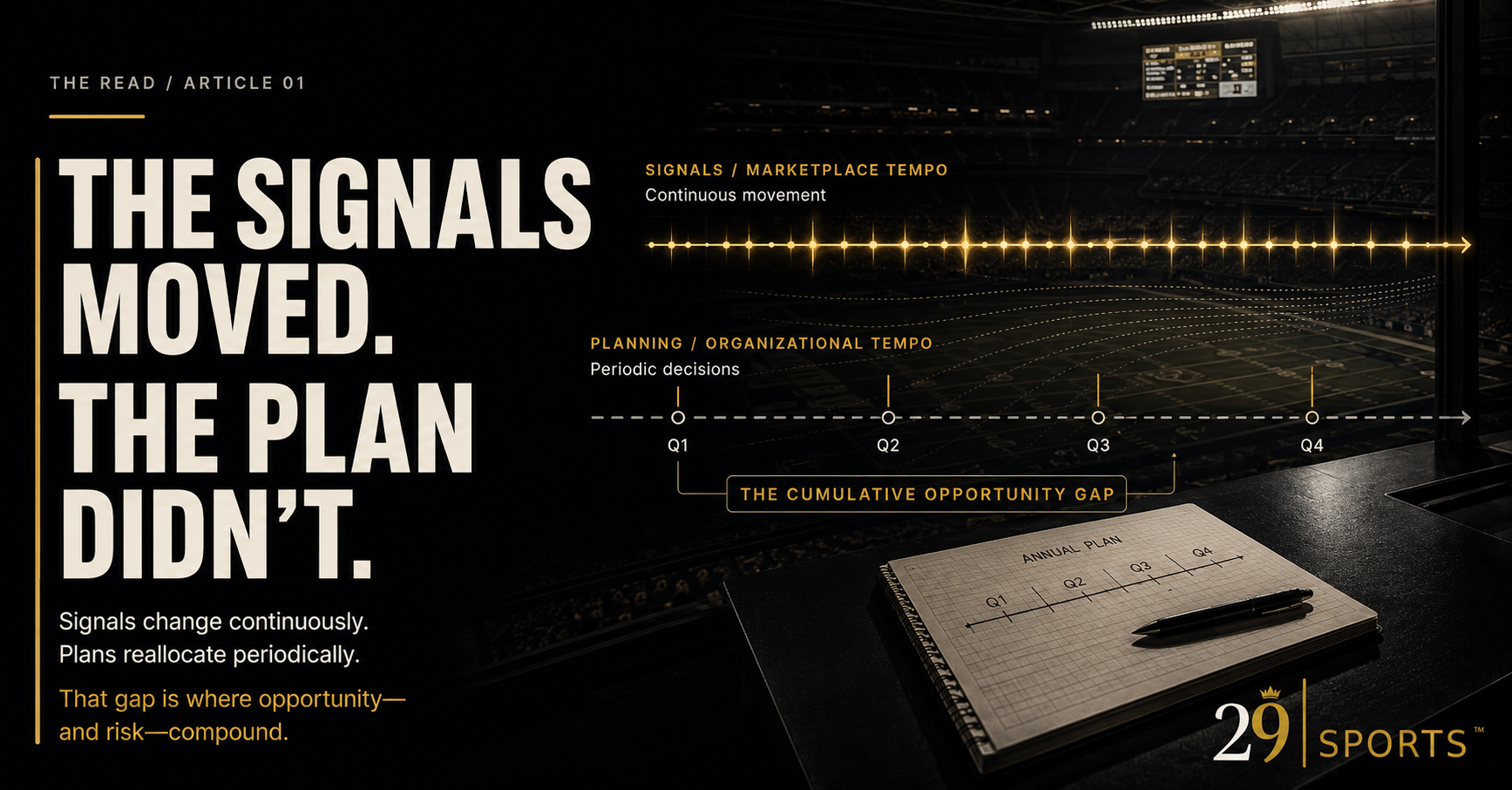
A sports organization can grow revenue, add partners and improve its operation while losing ground in the marketplace. Its results may be better than last year. Its options may be worse.
That is the problem with measuring progress only against your own history. While leadership evaluates the next move, competitors secure relationships, buyers change priorities and commercial opportunities become more expensive, or flat out disappear.
The sports marketplace has a tempo, and every organization has one too. Organizational tempo is the speed at which an organization recognizes change, understands its consequences and acts while meaningful options remain.
The challenge is knowing when to move. Waiting can protect an organization from a bad commitment. It can also allow a valuable opportunity to close. More information does not resolve that tension unless someone connects it to the decision.
We examined four examples across conferences, basketball and brand investment to understand how that tension plays out. They illustrate different relationships between marketplace change and organizational response, rather than establishing response speed as the sole cause of commercial success or failure.
For sports-business leaders, the practical question is the same: What has changed around a decision that your organization is still treating as settled? If you can’t answer that question, how do you know your plan still protects the value you’re pursuing?
Tempo Shift 1
The Pac-12 — When the Sports Marketplace Moves First
Signal at the Time
“The longer we wait, the better our options get.”
— George Kliavkoff, Pac-12 commissioner
The statement captured the decision facing the Pac-12. Conference leaders believed additional time could improve their media options, but the marketplace was changing while they waited. The question was whether time was strengthening the conference’s position or reducing the leverage it still controlled.
The collapse of the Pac-12 is often explained through media-rights negotiations, conference realignment or individual universities protecting their own interests. Those factors mattered, but they were not the marketplace change. They were the outcome of changes already underway.
Live sports media had become more valuable. Streaming platforms had entered the market, conferences were becoming national commercial properties, and universities were no longer evaluating conference membership primarily through geography, tradition and competitive history. Revenue, distribution, exposure and long-term stability had become more important.
The information was there. Competing conferences were expanding, media-rights values were rising, schools were changing affiliations and national reach was becoming more valuable than regional identity.
The Pac-12 continued pursuing a media agreement while attempting to preserve its existing structure. As uncertainty continued, individual universities gained stronger reasons to protect their own commercial futures. Each departure reduced the value and stability of what remained, making the next departure more likely.
Those decisions were increasingly rational from the perspective of each university. Collectively, however, they accelerated the conference’s decline.
The Pac-12 did not simply lose schools. It lost the relationships holding its commercial position together. Media value weakened, institutional confidence deteriorated and negotiating leverage shifted elsewhere. By the time the conference attempted to restore certainty, the marketplace had already changed the options available to it.
Tempo Observation
The Pac-12’s unraveling cannot be reduced to one failed negotiation or a single explanation about speed. Media economics, competing conference offers, governance and individual universities’ interests all mattered.
The tempo lesson is how those pressures interacted while the conference pursued an agreement. As schools considered alternatives, uncertainty affected confidence in the remaining membership. That uncertainty also affected the commercial proposition the conference was trying to sell.
Waiting can be a strategy when the opportunity window is expanding. When counterparties are securing alternatives and the value of the remaining arrangement depends on their continued participation, the cost of waiting needs to be reassessed.
That is the distinction leaders should take from this case. The question is whether the assumptions supporting a decision still hold and whether the organization can recognize when they no longer do.
The Pac-12 is now rebuilding with a new membership structure and another opportunity to establish commercial relevance. Seven new full-time members officially joined Oregon State and Washington State in July 2026, creating a nine-member conference for the 2026–27 season.
Its history will not determine whether that effort succeeds. Its ability to read the current marketplace and respond before its options narrow again will.
Tempo Shift 2
The ACC — When Improvement Is Not Enough
Signal at the Time
“The resolve from both parties to further enhance the partnership through innovation and creativity to continue to drive additional value remains our top priority.”
— ACC Commissioner Jim Phillips on the conference’s renewed ESPN agreement
The statement demonstrated that the ACC was not standing still. The conference and its media partner were pursuing innovation and additional value. The Tempo question was whether that improvement could occur quickly enough to match the changing marketplace around them.
The ACC presents a different challenge than the Pac-12. It did not experience an immediate collapse. It expanded membership, maintained national relevance and continued pursuing ways to strengthen its commercial position. Cal, Stanford and SMU joined the conference in 2024, extending its membership and national reach.
By many measures, the conference improved. The sports marketplace, however, did not measure the ACC only against its own past. It measured the conference against competitors improving at a different speed.
Media-rights agreements grew, conference affiliation became a larger source of institutional revenue, and the College Football Playoff increased the commercial importance of national visibility and collective scale. NIL, the transfer portal and continued realignment placed additional pressure on conferences to provide financial strength and long-term stability.
The benchmark moved. The relevant question was no longer whether the ACC was creating more value. It was whether the conference was creating value quickly enough to strengthen its position relative to the marketplace.
The more recent financial results sharpen the distinction. For the 2024–25 fiscal year, the ACC reported approximately $826.5 million in revenue and average distributions of $47.1 million to its 14 full-share football members. In the same reporting period, average distributions to full-share members were approximately $79.9 million in the Big Ten and $72.4 million in the SEC.
Those figures do not mean every school received the same amount. Membership terms and performance incentives affect individual distributions. They do show why record conference revenue, on its own, cannot establish that the ACC is gaining competitive ground.
The competitive results give that financial comparison additional weight. In 2024–25, ACC men’s basketball teams went 5–31 against the SEC and earned just four NCAA Tournament bids. The conference improved to eight bids in 2026, but only Duke reached the Sweet 16, compared with six Big Ten teams and four SEC teams. Improvement was real. So was the difference in postseason depth.
Football presents a similar distinction between individual strength and conference depth. In the November 1 AP poll, Miami ranked first nationally, but Wake Forest was the only other ACC team in the Top 25. An exceptional team can strengthen the conference’s visibility without resolving the broader competitive imbalance.
The ACC recognizes the commercial challenge. Commissioner Jim Phillips has publicly discussed closing the revenue gap and rejected waiting around for additional dollars. The conference has pursued sponsorships, expanded commercial relationships and changed how it rewards competitive success and television viewership.
Those are actions. Whether they are closing the gap is a different question. A new sponsorship can increase revenue without materially changing the conference’s position. A revised distribution formula can improve one member’s economics without increasing the total available to the conference. Neither, by itself, demonstrates that the ACC is catching the Big Ten or SEC.
Notre Dame helps clarify the distinction. Its national brand, independent football media agreement and broad fan base provide a degree of commercial flexibility few institutions possess. Notre Dame can maintain a partial relationship with the ACC because its individual influence gives it more options than most universities.
Most institutions cannot create comparable leverage independently. Their media exposure, revenue potential and long-term commercial positioning remain connected to the collective influence of their conference.
Commercial influence expands strategic choice. Without it, organizations become more dependent on the strength and speed of the systems around them.
Tempo Observation
The ACC demonstrates why organizational progress cannot be measured only by asking whether the organization is better than it was. Leaders must also determine whether the organization improved faster than the conditions shaping its future.
An organization can make sound decisions, create additional value and strengthen parts of its operation while still losing relative ground. Improvement matters, but it does not guarantee stronger positioning when competitors and marketplace expectations are moving faster.
Sports marketplace tempo is inherently relative. Organizations are not competing against their own history. They are competing against the current marketplace and the organizations best positioned within it.
What Makes Them Stay?
North Carolina, Miami, Florida State and Clemson are taking steps to preserve their ability to leave. What is the ACC doing that will make them choose to stay?
That is the question conference leadership should answer publicly. Which commercial changes will narrow the financial disadvantage, by how much and by when? What would make the conference’s future sufficiently attractive that these institutions stop looking for a better alternative?
If the ACC has that answer, this is the moment to explain it. Record revenue and additional sponsorships do not answer the question unless their effect is large enough to change the members’ calculation.
The Pac-12 shows why timing matters. Conference leadership pursued a collective future while individual universities evaluated alternatives. The value of staying depended partly on who else stayed. Each departure changed the proposition for those remaining, and decisions that protected individual institutions weakened the conference holding them together.
The ACC does not have to follow that path. But avoiding it requires a compelling answer before its members reach their own breaking points.
Does leadership know what would tip each institution toward leaving? Has it established what would persuade them to stay? And can its commercial strategy deliver that value before another conference offers a more attractive future?
Those are the measures against which a catch-up strategy should be judged. The ACC should show how its plan meets them.
The next media negotiation is a contractual milestone. It is not necessarily the deadline its members are using.
Tempo Shift 3
Basketball’s Global Expansion — What Basketball Can Learn from Soccer About Strengthening the Pipeline
Signal at the Time
“We have to start seeing some return on [academy investments], or I can’t look an owner in the eye and say this makes sense. This is not a philanthropy.”
— Don Garber, Major League Soccer commissioner
Garber was speaking about soccer, but the statement captures a question every growing sports ecosystem eventually faces. Development systems require significant investment, yet the organizations making that investment must still create a commercial and sporting return.
Basketball’s commercial rise created an unmistakable signal. The sport was becoming globally valuable, but that value was not moving evenly throughout the ecosystem. The NBA, global brands, media companies, athletes, national teams, youth organizations, tournament operators, facilities and local clubs were all participating in basketball’s expansion. They were not all capturing its value in the same way.
That difference became more important as the marketplace grew.
Basketball’s rise into one of the world’s most commercially successful sports appears, at first glance, to be a story of continuous growth. Participation expanded, international audiences increased, media rights grew, corporate sponsorship accelerated and players became global brands.
The size of the audience confirms that growth. FIBA research published in 2024 estimated more than 3.3 billion basketball fans globally, with interest increasing across the markets studied between 2019 and 2023.
Yet that success raises a different question. If basketball became dramatically more valuable over the past three decades, why do so many organizations responsible for developing and delivering the sport continue to face persistent commercial challenges?
The early 1990s marked the beginning of basketball’s transformation into a global commercial property. The Dream Team introduced the NBA’s biggest stars to audiences around the world, while improvements in television, international broadcasting and athlete marketing expanded the sport’s reach.
In the 1991–92 NBA season, the league included 23 international players from 18 countries. By the beginning of the 2023–24 season, that number had increased to 125 players from 40 countries and territories.
The opportunity was no longer simply to grow basketball participation. It was to build a global commercial ecosystem around the sport.
Multiple organizations recognized different parts of that opportunity. USA Basketball demonstrated the sport’s international appeal through competition. Nike recognized that basketball could become a global cultural identity extending beyond the court through athlete storytelling, footwear, apparel and lifestyle branding.
The NBA recognized that sustained commercial growth required more than individual stars. It expanded international media distribution, invested in Basketball Without Borders, supported youth-development initiatives, created international events and connected fans, players, broadcasters, sponsors and teams into a larger commercial ecosystem.
Basketball Without Borders illustrates the scale of that work. By 2025, the NBA and FIBA program had reached more than 4,600 participants from 144 countries and territories, with 142 former campers drafted into the NBA or WNBA or signed as free agents.
Each organization responded according to its role. USA Basketball developed national teams and international competition. Nike built athlete-driven brands and expanded basketball’s cultural influence. The NBA increasingly positioned itself as the coordinator of basketball’s global commercial ecosystem.
Over time, commercial leadership shifted toward the organizations capable of coordinating the greatest portions of that ecosystem. Basketball became one of the world’s most commercially valuable sports as the NBA expanded internationally, global sponsorships increased, media rights grew, international participation accelerated and player brands became businesses of their own.
The distribution of that value tells a more complicated story. Youth basketball sits inside a broader pay-to-play system in which costs and access remain persistent concerns. Aspen Institute research found that parents spent an average of $1,002 on a child’s primary basketball experience, while overall family spending on a child’s primary sport increased 46 percent between 2019 and 2024.
The marketplace grew and the ecosystem flourished. Commercial success did not expand evenly across every participant.
When Growth Does Not Strengthen the Pipeline
Basketball’s expansion creates a different tempo problem. The organizations developing players and delivering local participation do not necessarily gain commercial strength at the same rate as the leagues, media businesses and brands benefiting from the sport’s growth.
That does not establish that any one organization caused the imbalance or has responsibility for solving it alone. It does raise a consequential question: When does a development system become important enough to the commercial future of a sport that strengthening it becomes a business priority?
Major League Soccer offers a useful structural comparison. Its investments in academies, MLS NEXT and MLS NEXT Pro connect player development more directly to clubs’ sporting and commercial interests. The relevant comparison is how organizations invest in the environments that produce their future players, rather than which sport has achieved greater international success.
For basketball, the timing question is direct: Is investment in the pipeline keeping pace with the value being created around it? If participation grows while the organizations delivering it remain financially constrained, growth can conceal weaknesses that become more expensive to address later.
For a club, facility, league or brand, that changes the decision. A larger audience may justify investment, but leaders also need to ask: Who bears the development costs, who captures the resulting value, and which relationships could support a more sustainable model?
Marketplace growth creates opportunity. The commercial structure determines who can turn that opportunity into a durable business.
Tempo Shift 4
Ally Financial — The Courage to Act Before Consensus
Signal at the Time
“When we launched this pledge in 2022, we saw around a corner and believed women’s sports was the next significant space in sponsorships because of its positive trajectory—passionate fans, incredible athletes, untapped potential. But it needed partners willing to help make the infrastructure.”
— Andrea Brimmer, chief marketing and public relations officer, Ally Financial
Ally did not describe women’s sports as a charitable opportunity. It saw an emerging commercial market constrained by an infrastructure problem. The audience, athletes and momentum existed, but investment and media visibility had not caught up.
The previous Tempo Shifts show what can happen when marketplace change outpaces the organization. Ally demonstrates what becomes possible when an organization recognizes the shift before consensus forms.
Women’s sports had passionate fans, elite athletes and increasing cultural momentum. The opportunity was visible, but commercial investment and media coverage continued to lag.
That created a cycle. Limited coverage reduced visibility, lower visibility weakened the traditional business case for investment and lower investment restricted the infrastructure needed to create additional coverage, audience growth and commercial opportunity.
Organizations could see the potential. Many were still waiting for the marketplace to prove it.
Ally examined the marketplace and its own behavior within it. In 2022, approximately 90 percent of the company’s sports media spending went to men’s sports, while 10 percent went to women’s sports. Ally responded with a commitment to reach equal paid-media spending across men’s and women’s sports within five years.
That discovery changed the decision. Ally could continue waiting for the market to correct an imbalance its own spending reinforced, or it could act on the evidence already available.
The company worked with media companies, leagues and properties to build visibility, direct investment toward women’s sports and create commercial infrastructure around the opportunity. Its 2023 agreement with Disney dedicated more than 90 percent of the media investment to women’s sports and included sponsorship of ACC women’s championships.
Ally was not simply purchasing sponsorship inventory. It was helping build the market it believed was coming.
That distinction matters. Organizations that recognize an opportunity early can do more than benefit from commercial growth. They can influence how the market develops, which relationships form and where value accumulates.
Tempo Observation
Acting before consensus does not mean moving without evidence. It means recognizing when the available evidence is sufficient to justify action, even if it cannot eliminate every uncertainty.
By the time consensus forms, competitors have entered, prices have increased and the advantage available to early movers has narrowed. What once required conviction becomes obvious, and what was once an emerging opportunity becomes an established market.
Ally did not need perfect proof that women’s sports would become a significant commercial market. It needed enough validated understanding to recognize that the existing allocation of attention and investment no longer matched the direction of the marketplace.
The company moved before consensus. In doing so, it did not merely enter an emerging market. It helped accelerate one.
Ally reached its 50/50 media-spending commitment one year ahead of schedule after increasing its advertising investment in women’s sports media more than 4.6 times from its 2022 level.
Making the Shift
These cases point to a common leadership challenge. The information needed to reconsider a decision may already exist, but it is spread across relationships, departments and systems that evaluate different parts of the business.
Consider a sports property approaching a sponsorship renewal. Its sales team knows the contract is expiring. Its audience team sees changing fan behavior. Operations knows which promised benefits are difficult to deliver. The brand has its own changing business priorities.
Each team may be doing its job well. The commercial opportunity depends on understanding what those facts mean together before the renewal terms are fixed.
A larger audience does not automatically justify a higher price if it is becoming less relevant to the buyer. Strong reported exposure does not settle whether the partnership supports the brand’s objective. An attractive new benefit may have little value if the property cannot deliver it economically.
The decision could be to increase the investment, redesign the package, change the activation or investigate a different buyer. The right answer depends on the relationships among the facts.
Where 29 Sports Comes In
Our research has sharpened the question behind 29 Sports’ commercial work: What would cause a leader to reconsider a decision that still appears reasonable when each part of the business is viewed separately?
The ACC example shows why revenue growth needs to be read alongside competitors’ economics and individual members’ incentives. The Pac-12 shows why a negotiation cannot be separated from the alternatives available to the organizations holding it together. Basketball raises the relationship between commercial growth and the economics of development. Ally shows how a company’s own spending choices can either reinforce a market imbalance or help address it.
For 29 Sports, those connections are where the work begins. A pricing question may also be a rights question. A sponsorship question may be an activation or customer-growth question. A venue’s revenue problem may begin with programming decisions made well before the sales team receives the inventory.
We are developing a commercial intelligence product to help organizations close that gap by connecting pricing, partnership performance and emerging opportunities as the marketplace changes. The aim is to help leaders recognize where value is shifting and act before their options narrow.
The renewal example is an illustration of that approach, not a claim of a measured client result. The value must be established in the organization’s actual circumstances: its rights, buyers, economics, commitments and alternatives.
That is also why a sound recommendation needs more than an answer. It needs a clear explanation of what supports it, what remains uncertain and what would justify changing course. Otherwise, the organization risks continuing to act on a conclusion after the conditions that made it sensible have changed.
Before the Next Commitment
The objective is to understand soon enough to act while meaningful options remain. Sometimes that means moving quickly. Sometimes it means holding the current position because a new signal does not change the underlying decision.
For a property approaching a renewal, a brand considering an investment or a venue making long-term commercial commitments, the useful starting point is a specific decision with value at stake.
Bring that decision to 29 Sports. Through our strategic and commercial advisory work, we can examine the assumptions, relationships and alternatives shaping it and identify what needs to be understood before you commit.
Justified confidence has a shelf life. Your next decision should reflect the marketplace you are operating in now.
Bring the problem, and let’s make the right read. Start the conversation today.
Sources
- Arizona Daily Star. “Pac-12 media deal coming in ‘near future,’ commissioner George Kliavkoff says.” July 21, 2023.
- Pac-12 Conference. “The new Pac-12 Conference officially launches with the addition of seven full-time members.” July 1, 2026.
- Atlantic Coast Conference. “ACC and ESPN Announce Long-Term Renewed Commitment.” January 30, 2025.
- Atlantic Coast Conference. “The Atlantic Coast Conference Welcomes the University of California, Berkeley, Southern Methodist University and Stanford University as New Members.” September 1, 2023.
- Associated Press. “ESPN exercises option extending media base-rights agreement with the ACC through 2035–36.” January 30, 2025.
- Major League Soccer. “MLS Commissioner Don Garber a big believer in SuperDraft.” January 14, 2019.
- FIBA. “Popularity of basketball soaring globally, highlighted by increased interest in the FIBA World Cup.” June 28, 2024.
- USA Basketball. “The 1990s: Dream Team Changes Basketball Forever.” June 24, 2024.
- NBA. “WNBA, NBA and FIBA to host third Women’s Basketball Without Borders camp.” 2025.
- Aspen Institute Project Play. “Youth Sports Facts: Challenges.”
- Aspen Institute Project Play. “Family spending on youth sports rises 46% over five years.” March 3, 2025.
- Major League Soccer. “MLS NEXT launches bold new era in North American player development.” September 8, 2020.
- Major League Soccer. “Don Garber: 2024 MLS All-Star Game Media Availability Quote Sheet.” July 25, 2024.
- Ally Financial. “Ally Achieves Historic 50/50 Sports Media Pledge One Year Ahead of Schedule.” April 14, 2026.
- Ally Financial. “Ally and Disney create unprecedented media and collegiate collaboration to advance parity for women’s sports.” February 20, 2023.
- AP — 2024–25 distributions.
- WRAL — ACC men’s basketball performance and response.
- Sporting News — 2026 Sweet 16 by conference.
- November 1, 2026 AP football poll.
- AP — ACC sponsorship strategy, July 2026.
- WRAL — Four schools’ PCSA realignment objections.

Related Blog
More case studies and articles to keep people reading.


Newsletter signup
Lorem ipsum dolor sit amet, consectetur adipiscing elit. Suspendisse varius enim in eros elementum tristique.